You are here : Airfare > Belgium > Airfare to Brussels

Airfare to Brussels

Links
  Flight Brussels
Airline ticket Brussels
Flight ticket Brussels
Airfares Airfares
 
_

_
Airfares search to Brussels
_
 

Journey Type : Roundtrip One-way
From
To
Departure Date  Departure Date
Return Date
 Return Date
Adults More options (child, class,...)
Ticket Class
Infants
Direct flight
Search
 
_
Going to Brussels ? Looking for the lowest price for your Brussels flight ? Compare airfares with Jetcost : discounted Brussels flights, promotions, bargain airfares to Brussels, charter Brussels flight tickets and budget airline tickets offers.
Jetcost find the best Airfare for your flight to Brussels.

Find a cheap airfare and the best price for your Brussels vacation using Jetcost.
Book your Brussels ticket at the best fare in a couple of clicks.

Use the Brussels airfare search engine Jetcost and find your cheap Brussels air ticket in just a click.


Airfare to Brussels (Belgium)
 

Brussels

History

Charles V, heir of the Low Countries since 1506, though (as he was only 6 years old) governed by his aunt Margaret of Austria until 1515, was declared King of the unified Spain, in 1516, in the Cathedral of Saint Gudule in Brussels.

Upon the death of his grandfather, Maximilian I, Holy Roman Emperor in 1519, Charles became the new archduke of the Austrian Empire and thus the Holy Roman Emperor of the Empire "in which the sun does not set". It was in the Palace complex at the Brussels' Coudenberg, that Charles V abdicated in 1555. This impressive palace, famous all over Europe, had greatly expanded since it had first become the seat of the Dukes of Brabant, but it was sadly destroyed by fire in 1731. All that remains is an archaeological site.

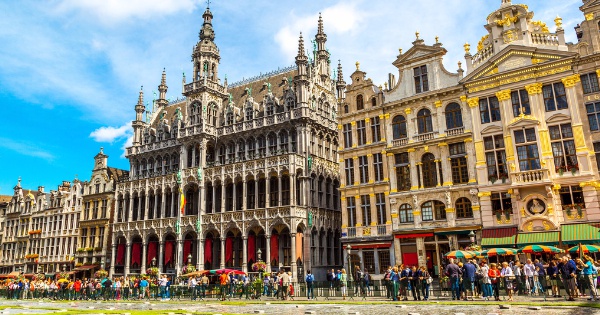
In 1695 Brussels was attacked by General Villeroy under the orders of King Louis XIV of France. The bombardment caused great destruction: more than 4,000 houses were set on fire, including the mediaeval buildings on the Grote Markt or Grand Place.

In 1830, the Belgian revolution took place in Brussels after a performance of Auber's opera La Muette de Portici at De Munt or La Monnaie theatre. On July 21, 1831, Leopold I, the first King of the Belgians, ascended the throne, undertaking the destruction of the city walls and the construction of many buildings. Following independence, the city underwent many more changes. The Senne had become a serious health hazard, and from 1867 to 1871 its entire urban area was completely covered over. This allowed urban renewal and the construction of modern buildings and boulevards which are characteristic of downtown Brussels today. The North-South Junction was built, completed in 1952. The first Brussels premetro was finished in 1969, and the first line of the Brussels Metro was opened in 1976.

Beginning on May 10, 1940, Brussels was bombed by the German army; however, most of the war damage to the city took place in 1944-1945. The Heysel Stadium disaster took place in Brussels on May 29, 1985. The Brussels Capital Region was founded on June 18, 1989.

Political centre

Although some believe, wrongly, that the capital of Belgium is the entire Brussels-Capital Region, article 194 of the Belgian Constitution lays down that the capital of Belgium is the City of Brussels municipality. Arguments that article 194's use of lower case for "ville de Bruxelles" and "stad Brussel" makes a subtle difference and means that greater Brussels being represented as the capital cannot be legally defended.

However, although the City of Brussels is the official capital, the funds allowed by the federation and region for the representative role of the capital are divided among the 19 municipalities, and some national institutions are sited in the other 18 municipalities. Thus, while de jure only the City of Brussels is entitled to the title of capital city of Belgium, de facto the entire Region plays this role.

The City of Brussels is one of the municipalities of the Brussels-Capital Region (the largest) and is the official capital of Belgium.

Somewhat in the way that the City of London is different from London, the City of Brussels is different from Brussels. However, the expansion of the City of Brussels was frozen at a later stage than the City of London. As a result, in addition to the old centre of Brussels, the towns of Haren, Laeken and Neder-Over-Heembeek, as well as Avenue Louise/Louizalaan (a main shopping street, similar in design to the Parisian Champs Elysées) and the Bois de la Cambre/Terkamerenbos (the largest park in Brussels) are included within the limits of the City.

The Brussels-Capital Region is one of the three federated regions of Belgium, alongside Wallonia and the Flemish Region. Geographically and linguistically, it is a (bilingual) enclave in the (unilingual) Flemish Region. Regions are one component of Belgium's complex institutions, the three communities being the other component: the Brussels inhabitants must deal with either the French (speaking) community or the Flemish Community for matters such as culture and education.

Brussels is also the capital of both the French Community of Belgium (Communauté française de Belgique in French) and of Flanders (Vlaanderen); all Flemish capital institutions are established here: Flemish Parliament, Flemish government and its administration.

Brussels has become a significant centre for international institutions, notably those of the European Union. The city also plays host to the headquarters of the North Atlantic Treaty Organisation (NATO) is based in the city along with 1000 other international organisations and 2000 international corporations. Brussels is third in the number of international conferences it hosts also becoming one of the largest convention centres in the world. The presence of the EU and the other international bodies has led to there being more ambassadors and journalists in Brussels than Washington D.C.. International schools have also been established to serve this presence.


Informations on Brussels More info about Brussels
 
_

Airfare to Belgium
 

Belgium

Communities and regions

Based on the four language areas defined in 1962-63, consecutive revisions of the country's constitution in 1970, 1980, 1988 and 1993 established a unique federal state with segregated political power into three levels:

The constitutional language areas determine the official languages in their municipalities, as well as the geographical limits of the empowered institutions for specific matters:

Although this would allow for seven parliaments and governments, when the Communities and Regions were created in 1980, Flemish politicians decided to merge both; thus in the Flemish Region a single institutional body of parliament and government is empowered for all except federal and specific municipal matters.

The overlapping boundaries of the Regions and Communities have created two notable peculiarities: the territory of the Brussels-Capital Region (which came into existence nearly a decade after the other regions) is included in both the Flemish and French Communities, and the territory of the German-speaking Community lies wholly within the Walloon Region.

Conflicts between the bodies are resolved by the Constitutional Court of Belgium. The structure is intended as a compromise to allow different cultures to live together peacefully.

The Federal State retains a considerable "common heritage". This includes justice, defence, federal police, social security, nuclear energy, monetary policy and public debt, and other aspects of public finances. State-owned companies include the Post Office and Belgian Railways. The Federal Government is responsible for the obligations of Belgium and its federalized institutions towards the European Union and NATO. It controls substantial parts of public health, home affairs and foreign affairs.

Communities exercise their authority only within linguistically determined geographical boundaries, originally oriented towards the individuals of a Community's language: culture (including audiovisual media), education, and the use of the relevant language. Extensions to personal matters less directly connected with language comprise health policy (curative and preventive medicine) and assistance to individuals (protection of youth, social welfare, aid to families, immigrant assistance services, etc.).

Regions have authority in fields that can be broadly associated with their territory. These include economy, employment, agriculture, water policy, housing, public works, energy, transport, the environment, town and country planning, nature conservation, credit, and foreign trade. They supervise the provinces, municipalities, and intercommunal utility companies.

In several fields, the different levels each have their own say on specifics. With education, for instance, the autonomy of the Communities neither includes decisions about the compulsory aspect nor allows for setting minimum requirements for awarding qualifications, which remain federal matters. Each level of government can be involved in scientific research and international relations associated with its powers.

Geography, climate, and environment

Belgium shares borders with France (620 km), Germany (167 km), Luxembourg (148 km) and the Netherlands (450 km). Its total area, including surface water area, is 33,990 square kilometres; land area alone is 30,528 km². Belgium has three main geographical regions: the coastal plain in the north-west and the central plateau both belong to the Anglo-Belgian Basin; the Ardennes uplands in the south-east are part of the Hercynian orogenic belt. The Paris Basin reaches a small fourth area at Belgium's southernmost tip, Belgian Lorraine.

The coastal plain consists mainly of sand dunes and polders. Further inland lies a smooth, slowly rising landscape irrigated by numerous waterways, with fertile valleys and the northeastern sandy plain of the Campine (Kempen). The thickly forested hills and plateaus of the Ardennes are more rugged and rocky with caves and small gorges, and offer much of Belgium's wildlife but little agricultural capability. Extending westward into France, this area is eastwardly connected to the Eifel in Germany by the High Fens plateau, on which the Signal de Botrange forms the country's highest point at 694 metres (2,277 ft).

The climate is maritime temperate, with significant precipitation in all seasons (Köppen climate classification: Cfb). The average temperature is lowest in January at 3 °C (37 °F), and highest in July at 18  °C (64  °F). The average precipitation per month varies between 54 millimetres (2.1 in) in February or April, to 78 millimetres (3.1 in) in July. Averages for the years 2000 to 2006 show daily temperature minimums of 7 °C (45 °F) and maximums of 14 °C (57 °F), and monthly rainfall of 74 millimetres (2.9 in); these are about 1 degree Celsius and nearly 10 millimetres above last century's normal values, respectively.

Because of its high population density, location in the centre of Western Europe, and inadequate political effort, Belgium faces serious environmental problems. A 2003 report suggested Belgian rivers to have the lowest water quality of the 122 countries studied. In the 2006 pilot Environmental Performance Index, Belgium scored 75.9% for overall environmental performance and was ranked lowest of the EU member countries , though it was only 39th of 133 countries.

Economy

Belgium's economy and its transportation infrastructure are integrated with the rest of Europe. Its location at the heart of a highly industrialized region helps make it one of the world's ten largest trading nations. The economy is characterized by a highly productive work force, high GNP, and high exports per capita. Belgium's main imports are food products, machinery, rough diamonds, petroleum and petroleum products, chemicals, clothing and accessories, and textiles. Its main exports are automobiles, food products, iron and steel, finished diamonds, textiles, plastics, petroleum products, and nonferrous metals. The Belgian economy is heavily service-oriented and shows a dual nature: a dynamic Flemish economy, with Brussels as its main multilingual and multi-ethnic centre, and a Walloon economy that lags behind. One of the founding members of the European Union, Belgium strongly supports an open economy and the extension of the powers of EU institutions to integrate member economies. In 1999, Belgium adopted the Euro, the single European currency, which fully replaced the Belgian franc in 2002. Since 1922, Belgium and Luxembourg have been a single trade market within a customs and currency union: the Belgium-Luxembourg Economic Union.

Belgium was the first continental European country to undergo the Industrial Revolution, in the early 1800s. Liège and Charleroi rapidly developed mining and steelmaking, which flourished until the mid-20th century in the Sambre-Meuse valley, the sillon industriel. However, by the 1840s the textile industry of Flanders was in severe crisis and the region experienced famine from 1846-50.


Informations on Belgium More info about Belgium
 
_


Jetcost France Jetcost.com | Jetcost España Jetcost.es | Jetcost United Kingdom Jetcost.co.uk